
ARN Security service brief
Canine Services
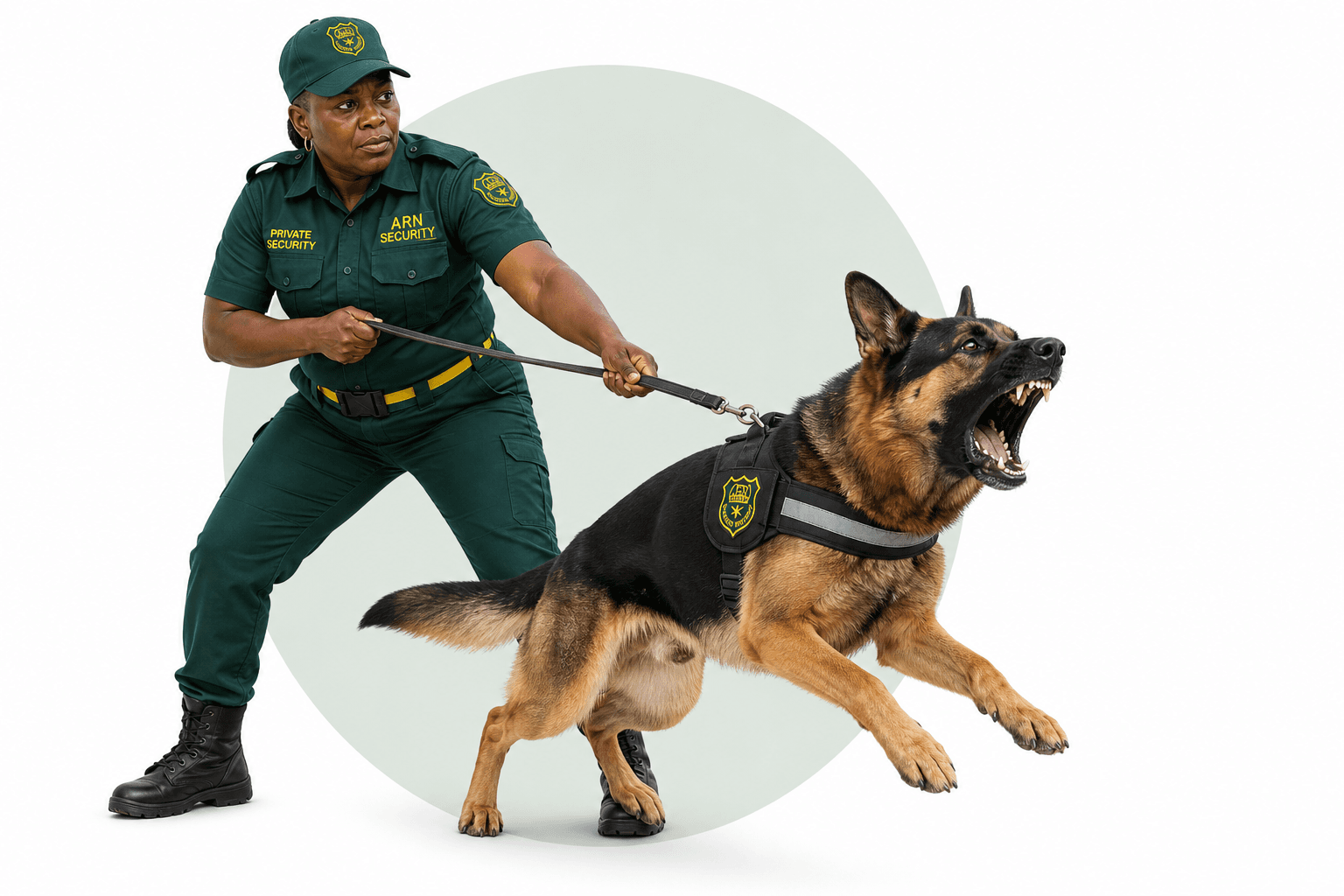
A trained handler-and-dog deployment for visible deterrence and patrol reinforcement in suitable perimeter environments.
- Stronger visible perimeter deterrence
- Handler-led patrols within agreed boundaries
- Canine welfare and site suitability built into the deployment
Decision brief
At a glance
- Best fit
- Larger compounds, warehouses, estates, remote operations, and night patrol environments with perimeter exposure.
- First step
- Assess patrol boundaries, site activity, accommodation, welfare, and interaction risks.
- Preparation
- Share layouts, working hours, staff and visitor movement, other animals, hazards, and suitable welfare facilities.
- Implementation range
- From a single planned deployment to a phased multi-site mobilization. Timing depends on site suitability, handler availability, welfare facilities, patrol boundaries, and induction.
Included work
What ARN provides
- Site-suitability assessment
- Handler pairing and patrol role
- Deployment schedule and boundaries
- Welfare, supervision, and incident routines
Engagement sequence
How implementation works
- 01
Assess
Review terrain, movement, hazards, other animals, patrol needs, and welfare facilities.
- 02
Plan
Define handler duties, patrol areas, schedule, controls, and integration with guards.
- 03
Introduce
Complete site orientation, controlled familiarization, records, and escalation contacts.
- 04
Supervise
Monitor welfare, handler performance, patrol records, and changing site conditions.
Service-specific controls
Operational detail
- The dog works with a trained handler and within defined patrol boundaries.
- Deployment times consider heat, terrain, public movement, and rest needs.
- Canine patrols complement, rather than replace, access control and response procedures.
Shared readiness
Client preparation and responsibilities
- Provide safe welfare and rest arrangements.
- Control unauthorized interaction with the dog.
- Disclose site hazards, other animals, and activity changes.
Assurance
Quality control and review
- Handler and patrol records
- Welfare and accommodation checks
- Incident and suitability review
Scope clarity
Scope boundaries
- Canines are not deployed without a handler.
- Unsuitable public, animal, or welfare conditions can prevent deployment.
- Use remains controlled and lawful; no attack guarantee is offered.
Operational questions
Questions clients often ask
Can a dog patrol alone?
No. ARN canine work is handler-led and follows agreed boundaries and safety controls.
Does every site suit canine deployment?
No. Welfare, public movement, terrain, other animals, and operational purpose must be assessed.
Can canine services work with guards?
Yes. The strongest model defines how the handler, guard posts, patrols, and escalation support one another.
Layered protection
Related services
Choose the next useful step
Turn the service brief into a site-specific plan.
Use the guided report for a structured first read, or speak directly with ARN about the site and operating context.